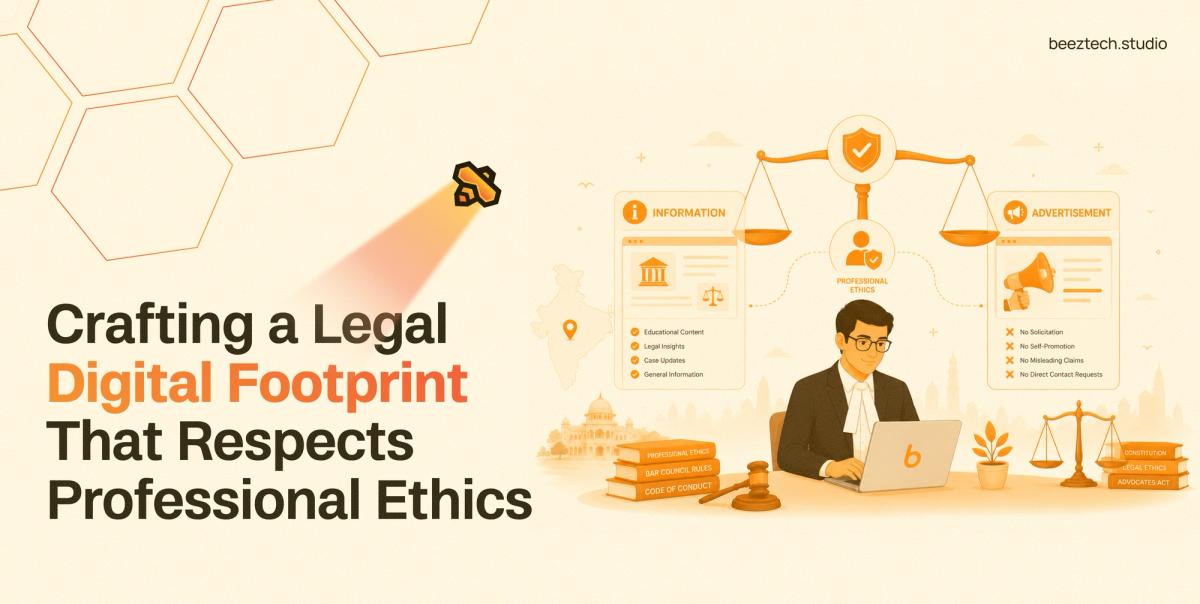
The line between professional information and prohibited advertising isn't obvious—especially online. A law firm publishes an article explaining recent case law. Is that educating the market or soliciting clients through disguised promotion? A practice area page describes your dispute resolution methodology. Is that transparency or marketing? A blog post about Section 34 arbitration challenges targets keywords your ideal clients search for. Is that strategic visibility or unethical advertising? Law firms struggle because the distinction matters legally and operationally. The distinction isn't vague. Information serves the profession and clients. Advertisement serves the firm's business interests. The problem: most law firms either conflate them (treating all content as implicit marketing) or avoid online presence entirely (treating information-sharing as risky). Neither approach works. The reality: properly developed digital infrastructure lets firms build significant online presence through substantive information—without crossing into prohibited advertising. It's a technical and strategic problem that most law firms solve incorrectly because they lack digital expertise.
The Core Distinction: Information That Educates vs. Advertising That Solicits
Information serves an educational purpose. It explains legal concepts, clarifies processes, or documents professional expertise. A blog explaining "How Section 34 arbitration challenges work" informs the market. Someone reading it learns the legal framework—whether they hire your firm or not.
Advertising serves a promotional purpose. It's designed to persuade potential clients that your firm is the solution to their problem. A landing page saying "Choose us for Section 34 challenges—we've never lost one" advertises.
The ethical distinction is clear. The digital execution is where firms stumble.
Why the confusion exists:
Most digital marketing is fundamentally advertising. SEO targets keywords to drive conversions. Social media posts highlight successes to generate leads. Landing pages use persuasion psychology. These are effective business tactics—but they're advertising, not information.
Law firms adopting standard digital marketing strategies inadvertently cross ethical lines because they're applying advertising frameworks to a profession that restricts advertising.
Where the gray zone lives:
- Optimizing informational content for search engines (is that educating or advertising?)
- Publishing case outcomes (is that substantive information or client endorsement?)
- Creating content around your practice areas (is that demonstrating expertise or promoting services?)
- Building thought leadership (is that professional contribution or implicit advertising?)
The gray zone exists because the internet collapsed the boundaries between information and persuasion. A well-written, well-optimized article educates readers AND drives traffic to your website. Both things happen simultaneously.
Professional ethics require you to ask: Does this content primarily inform, or does it primarily persuade clients to hire me?
Why Law Firms Can't Build Digital Presence Without Clarity on This Distinction
The practical cost of confusion is significant.
Scenario 1: Firms err toward pure information. They publish educational content with zero business intent. No CTAs, minimal contact information, no service positioning. Traffic arrives but generates no leads. The firm has invested in content but not in business outcomes. Worse: search engines reward pages with clear conversion intent. Pure informational content (with no business signal) ranks lower than strategically positioned content.
Scenario 2: Firms apply aggressive marketing. They treat their website like a B2B SaaS business. Popups asking for immediate consultations, countdown timers, comparison tables against competitors, testimonial sections, guarantee language. This generates leads—but exposes the firm to ethical violations and reputational damage if a bar council complaint follows.
Scenario 3: Firms do nothing. They assume digital presence is inherently advertising, so they avoid it. They remain invisible online while competitors capture clients through properly positioned digital strategies.
None of these work. The solution requires understanding how to be digitally strategic while respecting professional ethics.
How Digital Solutions Enable Information-Based Presence With Business Outcomes
The technical distinction between advertising and information-sharing is actually solvable through proper web development architecture.
Strategic content positioning: Educational articles optimized for search visibility generate traffic without making promotional claims. An article titled "Understanding Section 34 Arbitration Challenges: Recent Case Law Analysis" targets search intent while informing readers. The content can be simultaneously informative and strategically positioned.
Methodology transparency: Rather than claiming superiority, firms can document their approach. "Our arbitration practice: Initial legal audit → Strategy development → Pre-hearing preparation → Active representation" demonstrates professionalism and process clarity without making comparative claims or guarantees.
Substantiated experience documentation: Case outcomes framed as educational case studies (rather than testimonials) show real-world expertise. "Analyzed a Section 34 challenge against a Rs 500 crore arbitration award" is factual and demonstrates capability without solicitation.
Structural clarity on what's information and what's business: The website's information architecture itself communicates intent. Practice area pages can combine educational content (information) with clear service positioning (business intent) without conflating them. Example:
- Educational section: "Understanding trademark disputes in the Delhi High Court" (substantive legal information)
- Service section: "How we represent clients in trademark disputes" (service positioning, not advertising)
Backend compliance infrastructure: Proper web development ensures disclaimers are prominent, metadata is accurate, client confidentiality is protected, and communication channels are secure. The technology itself supports ethical practice.
Framework: Distinguishing Information From Advertising in Your Digital Strategy
Ask these questions for every piece of content:
Primary purpose: Does this content exist to educate the market, or to persuade potential clients to hire my firm?
If the answer is "both," that's fine—but you need to structure it so the information component stands independently.
Audience service: Does this content serve the reader's need to understand a legal concept, or primarily serve my firm's need to generate leads?
Educational content benefits readers who never hire you. That's the mark of genuine information.
Claim substantiation: Every claim in your content must be supported by fact. Can you substantiate it? If you say "our team handles complex cross-border arbitration," do you have case experience to support it? If not, it's advertising without foundation.
Comparative language: Does this content compare you favorably against competitors? Does it make superiority claims? If yes, it's advertising and likely violates professional ethics.
Persuasion intent: Is the content designed to persuade someone they should hire your firm? Or is it designed to help them understand a legal concept?
The subtle difference: "Here's how Section 34 challenges work" is information. "Here's how Section 34 challenges work, and here's why you should hire us" is advertising.
Practical Implementation: Building Compliant Digital Presence at Scale
Content strategy aligned with information hierarchy:
- Core educational articles on legal topics (neutral, substantive)
- Practice area pages explaining your expertise and methodology (professional positioning, not advertising)
- Team credentials presented factually (experience, specializations, no comparative claims)
- Process documentation showing how you work (transparency, not promotion)
- Substantiated case outcomes framed as learning examples (educational, not testimonials)
Technical infrastructure supporting compliance:
- Website architecture clearly separating informational content from service positioning
- Metadata that accurately represents content (no misleading titles or descriptions)
- Clear disclaimer sections visible to users
- Secure communication channels for client matters
- Analytics that don't expose client information
- No aggressive lead-generation tactics (popups, countdown timers, high-pressure CTAs)
Search engine optimization through information quality: Rather than aggressive SEO tactics, compete through substantive content. Optimize for informational keywords ("How Section 34 arbitration works") and intent-based keywords ("Section 34 arbitration representation Delhi"). Let information quality drive rankings.
Measurement: Track what matters: traffic from informational searches, engagement with educational content, qualified inquiries from informed visitors. These indicate you're building a legitimate information presence that happens to generate business.
Common Pitfalls in Legal Digital Strategy (And How to Avoid Them)
Pitfall: Treating all content as implicit marketing. This leads to over-disclaimered, passive websites that don't build authority.
Solution: Write genuinely educational content. If it educates readers independently of your firm's existence, it's information—publish it confidently.
Pitfall: Using marketing frameworks designed for non-regulated industries. Standard digital marketing applies advertising principles. Law firms need different frameworks.
Solution: Partner with digital solutions providers who understand legal ethics, not generic marketing agencies.
Pitfall: Confusing "SEO" with "advertising." Optimizing educational content for search engines isn't advertising. It's making good information discoverable.
Solution: SEO through information quality (research depth, topical authority) is compliant. SEO through manipulation (keyword stuffing, false claims) is not.
Pitfall: Making business intent invisible. Some firms hide their service positioning so thoroughly that potential clients can't figure out how to engage.
Solution: Be transparent. Clear service pages, contact information, and consultation processes demonstrate professionalism—not advertising aggression.
Conclusion: Ethics as Digital Strategy
The firms building the strongest digital presence aren't those testing ethical boundaries. They're those who've aligned professional ethics with strategic visibility. They publish substantive information, document their expertise transparently, and structure their digital presence to educate while being discoverable.
This requires a different approach to web development and content strategy than standard digital marketing. It requires understanding both legal ethics AND digital strategy. It's a specialized problem—which is precisely why it's an opportunity.
If your current digital presence creates ethical anxiety, underperforms on visibility, or fails to generate qualified inquiries, it's time to audit your strategy. The solution isn't choosing between ethics and visibility. It's building infrastructure where they align.
Frequently Asked Questions
Can law firms do SEO without violating professional ethics? Yes. SEO becomes problematic only when it involves deception (false claims, keyword stuffing) or aggressive tactics (aggressive popups, countdown timers). Optimizing educational content for search visibility, earning backlinks through substantive work, and improving website structure all support discoverability while maintaining ethics. Focus on information quality, not advertising manipulation.
Is publishing case outcomes a violation of professional ethics? Not if framed correctly. Case outcomes presented as educational examples ("Analyzed a Section 34 challenge in infrastructure arbitration") are information. Outcomes presented as endorsements ("Our clients rave about results") violate ethics. The key: educational framing, no explicit client endorsement, no naming clients without permission. Substantiated case documentation demonstrates expertise—that's professional.
What's the difference between a law firm blog and advertising content? A blog educates readers about legal topics, processes, or case law. Educational blogs benefit readers whether they hire your firm or not. Advertising content persuades readers that your firm is the solution. The distinction: Does the content stand alone as valuable information, or does it only have value if the reader hires you?
Can law firms use social media without it being advertising? Social media itself is inherently promotional—it's designed to drive engagement and action. Law firms should use it carefully. Sharing educational content (case law analysis, legal updates) is more defensible than promotional posts. Avoid: testimonials, guarantees, comparative claims, aggressive CTAs. Focus on professional contribution rather than self-promotion.
Is listing client experience advertising if it's on your website? "Successfully represented clients in 50+ commercial disputes" is factual information about experience. "Read our client reviews—5 stars!" is advertising through testimonials. The distinction: substantiated facts about your practice are information. Client endorsements are advertising. Document experience factually, avoid soliciting endorsements.
How do we measure if our digital presence is compliant? Ask: Does the content educate readers whether they hire our firm? Are all claims substantiated? Do we avoid comparative language? Is persuasion intent implicit, not explicit? Does the site structure separate information from service positioning? Are there no aggressive lead-generation tactics? If yes to most, you're likely compliant. Consider a professional review if uncertain.
What should law firms avoid in their digital presence? Avoid: guarantee language ("We always win"), testimonials with explicit endorsements, comparison claims against competitors, aggressive CTAs (popups, countdown timers), unsubstantiated outcome claims, pressure tactics, exaggeration of expertise or specialization. Avoid treating your website like a B2B SaaS business. Professional ethics require a different approach.
Strategic Resources & Links
- Core Service: Web App Development
- Related Services: Digital Marketing | Branding
- Learn More: Beeztech
- Book a Strategy Session: Schedule a Consultation
- Find Us: Udaipur Location
Related Blog Insights for Legal Practices
- Navigating Bar Council Rule 36: How to Build a Fully Compliant Law Firm Website Without Crossing Into Solicitation
- Web Dev Decoded: AI vs Frontend vs Backend for Business Growth
- 2026 Web Development Trends: Building Resilient Sites for Indian Businesses
- The Future of Visibility: AI-Driven SEO Services in India for Rajasthan's Growing Economy
- SaaS Development Blueprint: Launching Scalable Platforms in 2026
External Authority References
- Bar Council of India Official Guidelines – Authoritative source for professional conduct rules governing lawyer advertising and information sharing.
- American Bar Association Model Rules of Professional Conduct – International professional framework on the information vs. advertising distinction in legal practice.
- Harvard Law School Forum on Corporate Governance: Legal Ethics in Digital Age – Strategic analysis of how digital platforms reshape professional ethics in legal practice.